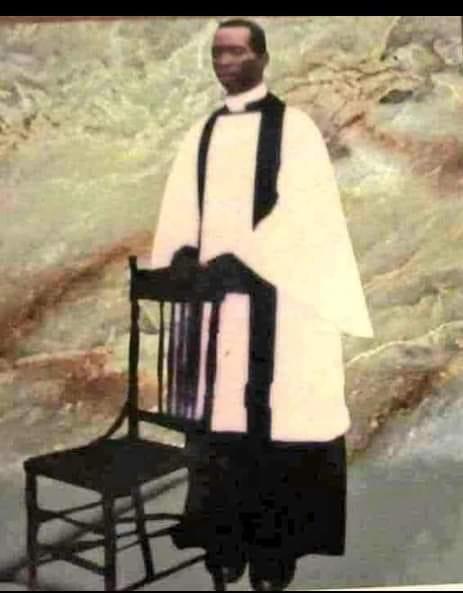
HOLY NWEJE: The Story Of An Igbo Saint:
Hezekiah Okoro Nweje, was an Anglican priest.
A native of Onitsha in Anambra state. He was born in 1919 and died in June 1962.
He was nicknamed "Holy Nweje" because of his very humble, extreme righteous, easy going & a humanitarian life he lived. He was tenaciously devoted to the things of God. Whatever gifts he receives from the church he shepherded was always shared with those in the vineyard, the poor and the less privileged. He doesn't hoard·them at the expense of the needy.
In his philosophy, he believed that wealth was sharing what you have without hoarding it. At a time, he was nominated for the position of the Anglican Bishop on the Niger, he declined and nominated someone he felt was more qualified
Rev. Hezekiah Okoro Nweje was seen as an upright, spotless and a righteous man. It was all those outstanding qualities he possessed while alive that brought about the name "Holy Nweje". Depicting how holy one can be. He believed ones anger should not see the next moment.
In May 1956 Onitsha and Obosi were tussling for a piece of land, Rev Nweje was called as a witness, he told the Judge that none of the towns owned the land, na "Ani bu ani Chukwu" The land and thereof is of the lord. That ended the land tussle. He was always on the side of peace.·
Around April 1956, during the daytime local thieves invaded his house in Onitsha and stole tubers of yam and fowl, he ran after them and told them to come and take more cited hunger as the reason for their unconventional behavior. What a man!
Growing up in Igbo land, if seen or perceived as an upright person, you would be called or nicknamed "Holy Nweje" When next you're called HOLY NWEJE, do not feel ashamed or mocked. It tells good of you. Nweje Lane in Onitsha metropolis is a street named to immortalize him.
(uploaded by Engr Jonathan N Chukwu -CJ)
 What is the importance of IKO UWA in Nenwe Mythology? And can that align to DNA tests in modern day paternity checks?
question by Mr Martin Okafor.
FURTHER QUESTIONS & PRELIMINARY REACTIONS:
- This is a big one. A belief in life after death. Why do the dead person come back not just to one person but sometimes to many families as well as in both sexes? (Engr. Aaron Okorie Ph D).
- Some living legends are said to lọọ ụwa la ṅdụ.
- Though my family is Christian and we don't go to where ịkọ chi is done, it was said my grandfather, Mazi Lazarus Ọrjị Ugwueke, lọtarụ m la ṅdụ. (Ogbuevi Tony.Osy. Ugweke)
- Sir, I guess, this concept is too deep. I have heard about Ilo UWA la ndu. there are lots of complexities in this concept. What about those women that lost their husbands early enough, probably were persuaded to stay back and have kids for her late husband. And in this instance, those kids that came after the husband must have died, how does ilo uwa apply here? When we all know that the kids came through a man not from that family.(Martin Okafor).
- Haaaa!! My bossom brother, are those children born " behind" their fathers not members of their fathers' families?
As long as the uncle of such children take them to the native priest to inquire who incanated into them, there will be an answer.
I have never heard that someone was taken to where to find out " onye lotaru ya" and the result came out negative. The process continues until the egg breaks, which signifies authentic result. I have never heard of rejected result of such an inquiry to call for a repeat. So, ikuwa is one of the numerous cosmovision's ( relationships between the physical world and the spiritual world) that characterize indigenous knowledge. There are instances, the dead man or woman will inform his or relation in a dream that he or she ( the deceased) is coming to the family. If the deceased has a scar or wound the new born baby will have that scar to confirm once lotaru ya, without going to see a fortune teller. Okammuta Ede (Godwin Chukwu Ph D)
"Epeteke zegbo, ọ lahụwa l'éwa ya"
EPETEKE ZEGBO... explained.
Epeteke is a kind of Nenwe onomatopoeia that depicts plenty but tiny in nature; like ụmụ mperete.
In the proverb, it refers to tiny yam seedlings.
Epeteke éwaji - tiny and sickly yam seedlings
Mgbii éwa ji - sizeable and halthy yam seedlings (see attached pix.
 So what the proverb is saying is that if one decides to cut tiny his yam seedlings, he may get very greeny yam leaves but after all, he will harvest tiny yams. Its Bible equivalent: if you sow sparingly, you reap sparingly while the computer people say garbage in, garbage out.
Lesson: Give adequate measure of inputs to expect reasonable output.
BY:Sai Nwaenya (Prof)
FRIDAY ORIE (08th May 2020)
FURTHER DISCUSSIONS:
Proverbs are very narrow ways of saying wide variety of things. Their usage depends on what prompt(s) them.
I used it as a farmer here. If as a road safety officer, you are to work under a contractor boss from Europe who disturbs you too much; you may console another officer who is equally disturbed by the European character not to worry, after all ọ kwa epeteke zegbo....
So the two explanations can work. The only major difference is that the second voice approached the explanation Etymologically. Ie, trying to dig into the root of its coinage.
As a student, if you see one who reads so much but fails his exams, you can still use the proverb to address someone who wants to show a feeling that that student is the best in the class: you can say; ya gụwalụ ya, afterall, ọ kwa epeteke zegbo... It has a synonym: "ụkwa megbo ọ danga l'ukwu ye.
II
BY:Sai Nwaenya (Prof)
FRIDAY ORIE (08th May 2020)